CS-01 · COMPLIANCE UX · INVESTOR ONBOARDING · CAPITAL MARKETS

KYC that ships in 12 minutes. From 45. Across 20+ jurisdictions.

I redesigned investor onboarding from a six-document, 45-minute paper trail into one 12-minute adaptive flow — collapsed jurisdiction branching, replaced wizards with a state machine, surfaced compliance status in real time. Shipped to Canaccord, Raymond James, and Sprott across $2B+ in regulated transactions.

45 → 12 min
Average completion time, cut by 73%
85%
Investor completion rate, up from 47%
150+
Offerings shipped, 20+ jurisdictions
Katipult compliance officer investor detail — single investor view with Identity, Jurisdiction, Accreditation, Source of Funds, and eSign all passed across IIROC, Reg CF, MiFID, and FINTRAC, plus decision panel and audit trail
Role
Head of Product Design
Timeline
2014 – 2025
(11 years)
Team
Founding designer
→ 30+ company
2 design reports
Clients
150+ institutional dealers
incl. Canaccord Genuity, Raymond James, Sprott Capital

Founded the design practice and ran it solo for three years. As the company grew to 30+, design's role got built inside it — every investment defended in numbers the business already tracked: drop-off rates, audit risk, dealer churn. Owned the design system, the jurisdiction-rules engine, and the compliance dashboard. Kept the in-house team lean — 2 full-time designers (Prague, Serbia) + external designers brought in as projects required. By the time Markette acquired the company, design was reviewing every major release. Time to move on.

( 01 )Direct contributions

What I personally designed.

  • Investor onboarding flow. Cut KYC from 45 → 12 minutes; lifted completion 47% → 85%.
  • Jurisdiction-rules engine UX. 20+ regulatory states (IIROC, Reg CF, MiFID, FINTRAC) on one configuration surface.
  • Compliance-officer dashboard. Human-side governance that dropped NIGO submissions and let automation handle high-confidence cases.
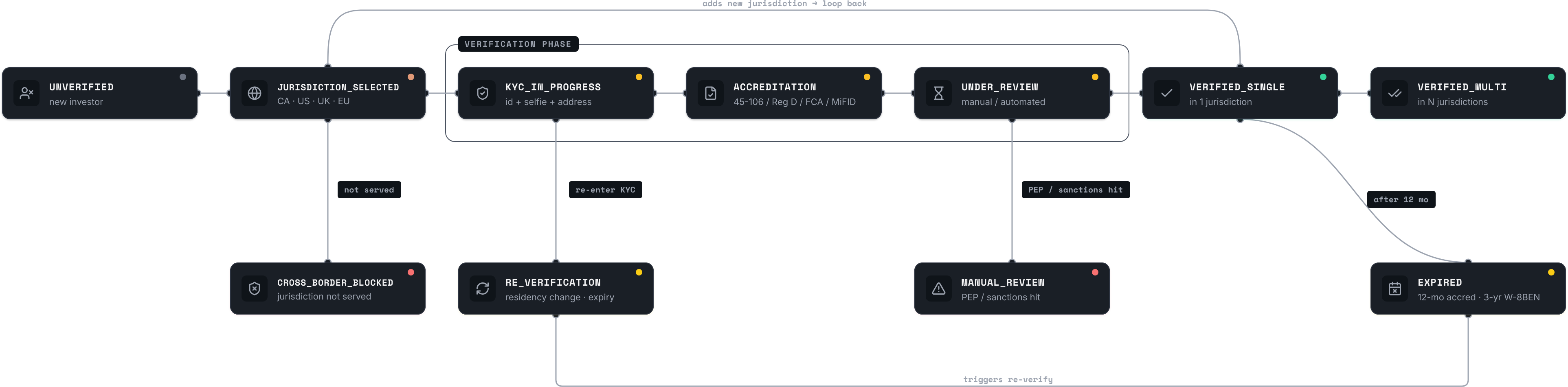
  • State-machine pattern replacing the wizard — the load-bearing design lever; same engine later shipped to Lending and Donations & Rewards verticals.
  • Design system architecture. Component library used across 17 enterprise tenants. Kept the design practice lean — 2 full-time designers (Prague, Serbia) + external designers brought in as projects required.

Cross-functional collaboration with engineering (backend implementation), compliance officers (regulatory interpretation), and the institutional dealers (user research observation on their floors) informed the work — but the design ownership was mine.

( 02 )Problem
Drop-off at document upload
60%
Before
45%
Overall completion improvement
15%
After
Higher conversion Faster completion Reduced support

60% of investors abandoned at document upload.

Six to eight documents in one session, no save-and-resume. The same flow for a California accredited investor and a UK retail investor. Compliance officers had no dashboard view of who was stuck or why. The platform was processing private placements for top institutional dealers, but losing investors before they finished signing up.

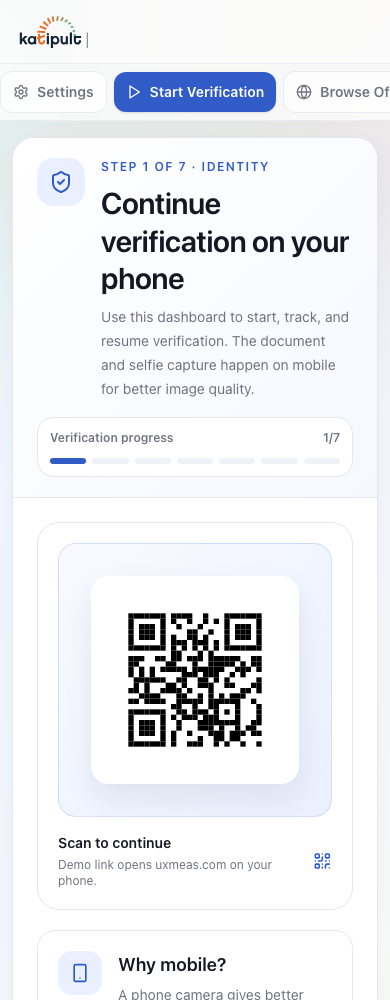
Mobile document review state on the legacy Katipult flow — investors stuck reviewing a captured ID with no clear path to fix or retake Mobile follow-up state on the legacy Katipult flow — system asks for more source-of-funds evidence after the user thought they were done, a major drop-off trigger
( 03 )Approach

Two ways into the investor experience.

Investors didn't abandon because the process was hard. They abandoned because it gave them no information, no progress, and no way to pause.

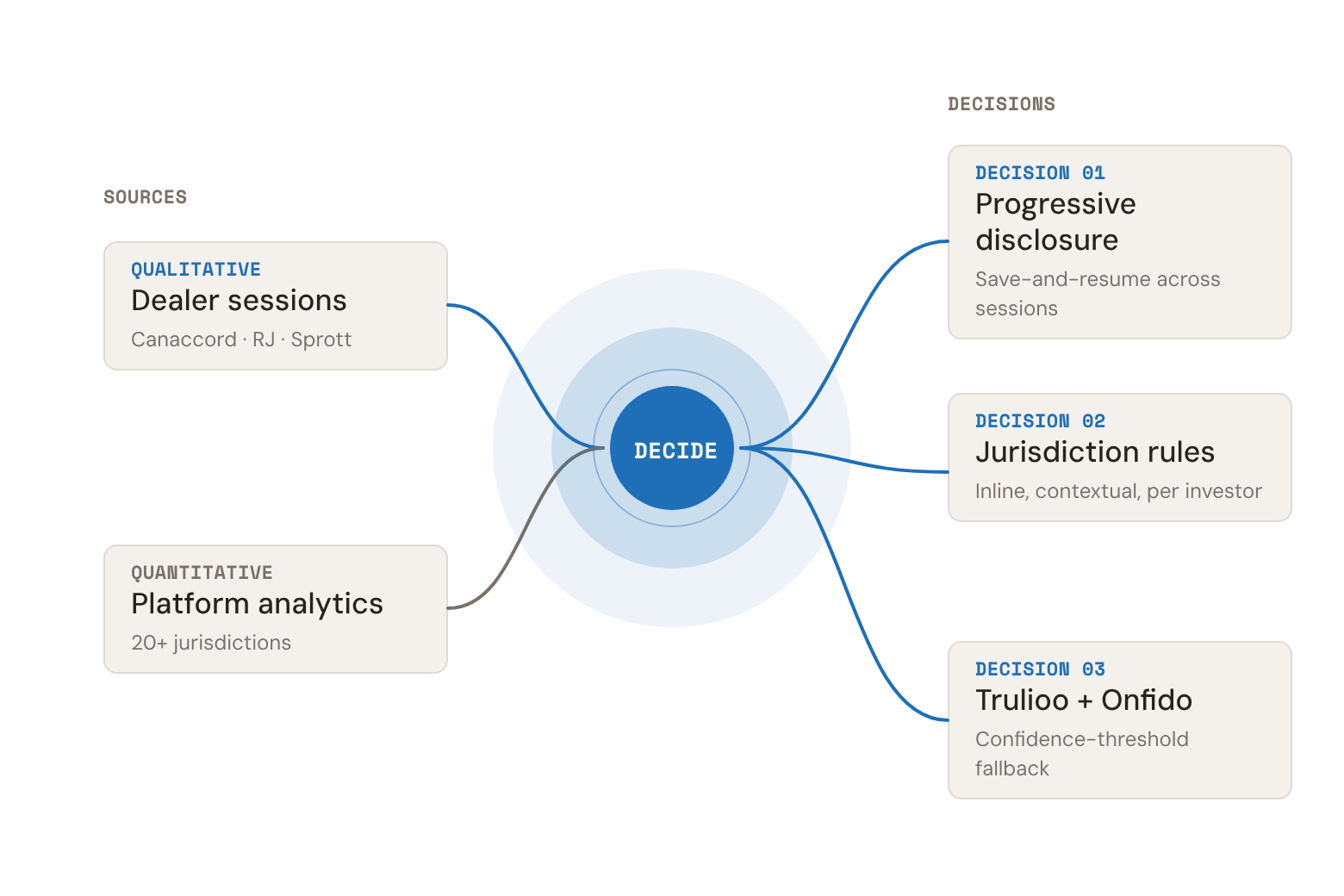
I designed the research. The dealers ran it. Canaccord, Raymond James, and Sprott had daily access to real investors, so I set the protocol and their teams observed sessions on their floors. Their notes came back weekly. Platform drop-off analytics ran in parallel and confirmed the same patterns across every jurisdiction.

How might we

Cut investor onboarding from 45 minutes to 12 — without losing compliance across IIROC, Reg CF, MiFID, ISA, and FINTRAC.

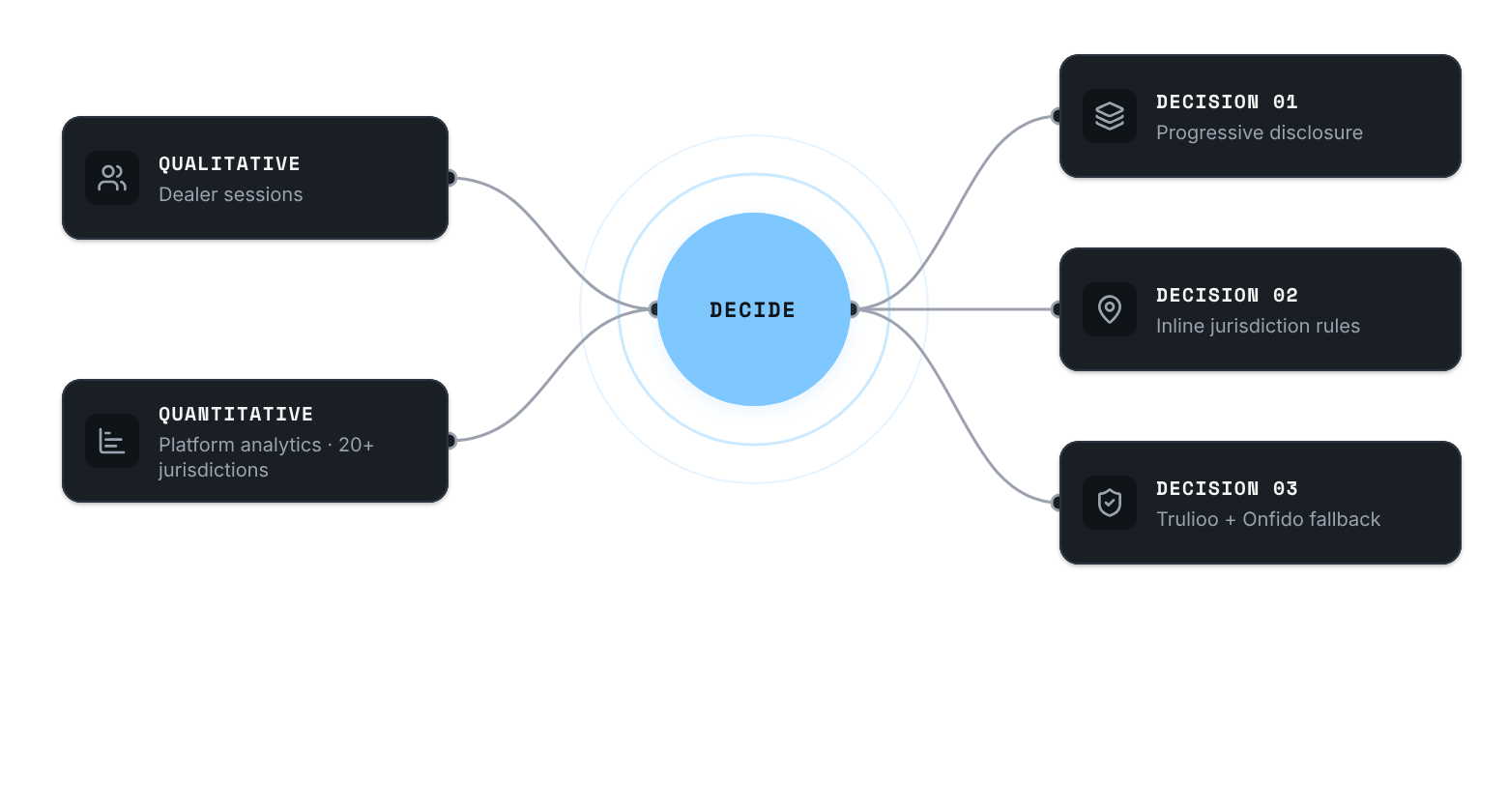
Hub-and-spoke diagram. SOURCES: Qualitative — Dealer sessions at Canaccord, Raymond James, Sprott; Quantitative — Platform analytics across 20+ jurisdictions. Both converge at the Synthesis hub. DECISIONS: 01 Progressive disclosure with save-and-resume, 02 Inline contextual jurisdiction rules, 03 Trulioo and Onfido with confidence-threshold fallback.
( 04 )Decisions

KYC is a state machine, not a form.

Regulators think in states. Users think in steps. The product's job is to translate between the two.

Jurisdiction state machine: 11 states + exception paths for cross-border blocked, manual review, expired, and re-verification

Three trade-offs along the way.

Decision 01

Progressive disclosure with save-and-resume.

Was
6 to 8 documents on one screen, no pause, no progress signal.
Chose
One decision per screen. Persistent state. Return any time.
Because
Drop-off data: 60% abandoned mid-session. Investors needed permission to leave and finish later.
Decision 02

Contextual jurisdiction rules, not global settings.

Was
Rules buried in separate settings screens before reviewing investors.
Chose
Rules surfaced inline in the review interface, per investor's jurisdiction.
Because
Officers reviewing IIROC investors needed IIROC rules visible — not buried in a settings panel they had to navigate to.
Decision 03

Trulioo and Onfido with confidence-threshold fallbacks.

Was
Manual document review for 20+ country formats.
Chose
Automated identity verification. Manual fallback only when confidence scores failed.
Because
20x compliance team headcount wasn't feasible. Automate the high-confidence cases, route the rest to humans.
( 05 )Process

Three principles that shaped the shipped flow.

Mobile residency capture — first step of a three-question jurisdiction flow that separates legal residence, tax residence, and citizenship into one decision per screen.
Moment 01

One decision per screen.

Residence, tax residence, and citizenship — three things investors kept getting wrong on a single form. Split them into three screens, one question each. Small enough to leave and come back to.

Mobile document capture — single focused upload zone with clear viewfinder framing, capture affordance, and contextual help instead of a generic file picker.
Moment 02

Focused capture, not a file picker.

Document upload as a single guided capture step instead of an 8-document dump. Viewfinder framing, clear progress, one document at a time. Investors stopped uploading the wrong file.

Mobile source-of-funds category — single decision pick across canonical categories with progressive disclosure, instead of a long-form text-entry field.
Moment 03

Pick, don't write.

Source-of-funds was free-text before — investors wrote "savings", "work", "inheritance", and compliance had to interpret each one. Replaced it with a category pick. Evidence is only asked for when the category needs it.

( 06 )Final flows

Three screens that defined the system.

KYC Start Screen

The opening screen doesn't ask for anything. It explains what's needed, how long it takes, and what happens to the data before a single document is uploaded. Trust is established before compliance begins.

Mobile KYC welcome screen on the shipped Katipult flow — explains required documents, time estimate, and encrypted data handling before any upload Mobile tax residence capture on the shipped Katipult flow — single-question step inside a three-screen jurisdiction sequence that separates legal residence, tax residence, and citizenship
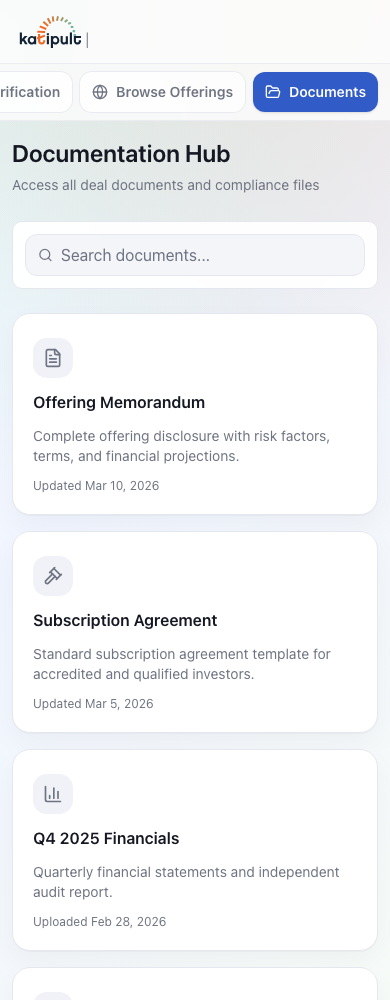
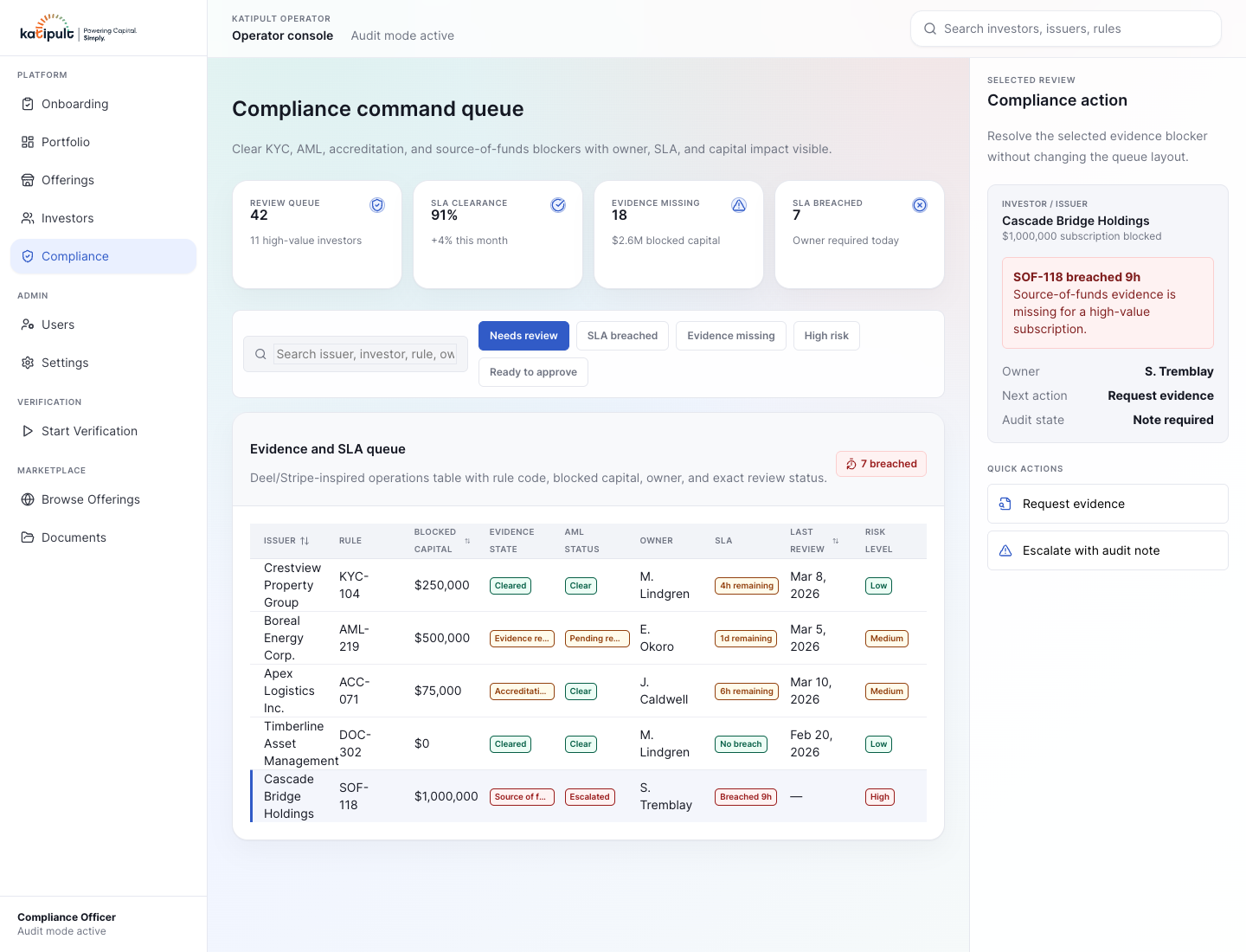
Compliance officer queue view on the shipped Katipult dashboard — every investor's exact status across every jurisdiction, with status badges, last-active timestamps, and per-row review affordance

Compliance Dashboard

Compliance officers see every investor's exact status across every jurisdiction. Not just "complete" or "incomplete" but which step they're on, what's blocking them, when they last logged in, and which framework applies (IIROC, Reg CF, MiFID, ISA). Replaced a spreadsheet workflow that required manual chasing.

Operator Alert Surface

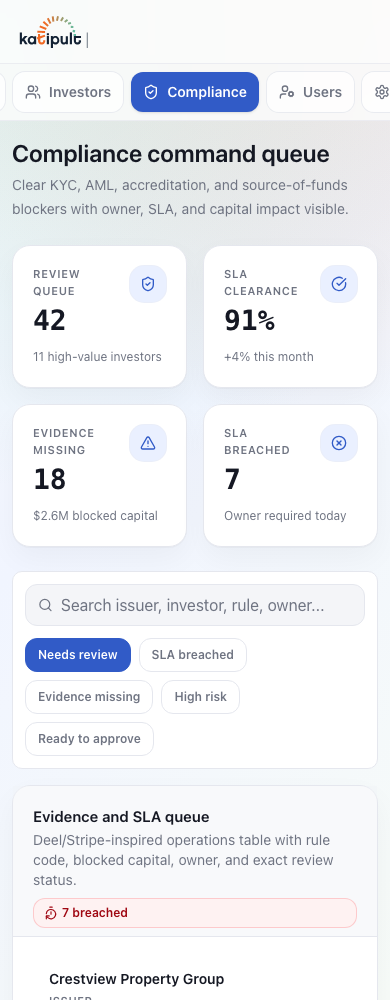
Compliance officers' triage view. Critical, High, Medium severity, with the regulator rule that fired, who owns it, and how long it's been sitting. The previous workflow was a Slack thread plus a spreadsheet — by the time you found the right investor, half the SLAs had blown. This replaced both, with an audit log attached to every action.

Operator alert dashboard on the shipped Katipult system — cross-dimensional triage view with severity-tagged alerts (Critical, High, Medium), AML rule codes, SLA timers, and per-row escalation affordances
( 07 )Results

Ran for 11 years across 20+ regulatory jurisdictions.

$2B+
Private capital processed on the platform
11 yrs
In production across institutional dealers
20+
Regulatory frameworks (IIROC, Reg CF, MiFID, ISA, FINTRAC, FCA…)
4 products
Same engine: Compliance, DealFlow, Lending, Donations & Rewards

NIGO (not-in-good-order) submissions dropped enough that ECM teams stopped chasing corrections and started closing deals. The compliance team grew slowly while investor volume kept climbing — automation handled the high-confidence cases, humans owned the exceptions.

The same engine eventually shipped to two sister products: Lending (Singapore, Mexico, UK, US deployments) and Donations & Rewards (InvestYYC + Alberta BoostR with Calgary Arts Development and ATB Financial).

( 08 )Reflection

What worked

Progressive disclosure reduced cognitive load in a domain where cognitive load directly costs money. The jurisdiction-aware rules engine is the feature compliance officers cite most often. Save-and-resume was the single biggest behavioral change — it turned a high-stakes single session into a returnable process. Trulioo and Onfido integration scaled identity verification across 20+ jurisdictions without a 20× headcount increase on the compliance team.

What to do differently

Mobile-first from day one. The platform was retrofitted for mobile years after desktop launch, creating layout debt that took multiple sprints to address. Earlier investor-side usability testing too — research relied heavily on compliance officer observation, and spending equal time with the end investors (not just the admins watching them) would have surfaced friction sooner.

Three takeaways. Compliance isn't a UX blocker. It's the brief. Wizards break when paths split. State machines don't. The people closest to users — dealers, compliance officers — know more than any lab. I use all three now.

Up next · 02 / 04

Katipult

Three products. One engine. $2B+ in regulated transactions across 17 enterprise tenants and three product verticals — DealFlow, Lending, and Donations & Rewards.

Read case study