
CS-02 · KATIPULT · COMPLIANCE PLATFORM · CAPITAL MARKETS

Three products. One engine. $2B+ in regulated transactions.

Katipult is the white-label deal platform behind three revenue segments — Debt & Lending, Canadian Equity, and Global Equity. Shipped to 17 enterprise tenants across 6 continents. Co-founded, designed, and scaled to a TSX-V IPO.

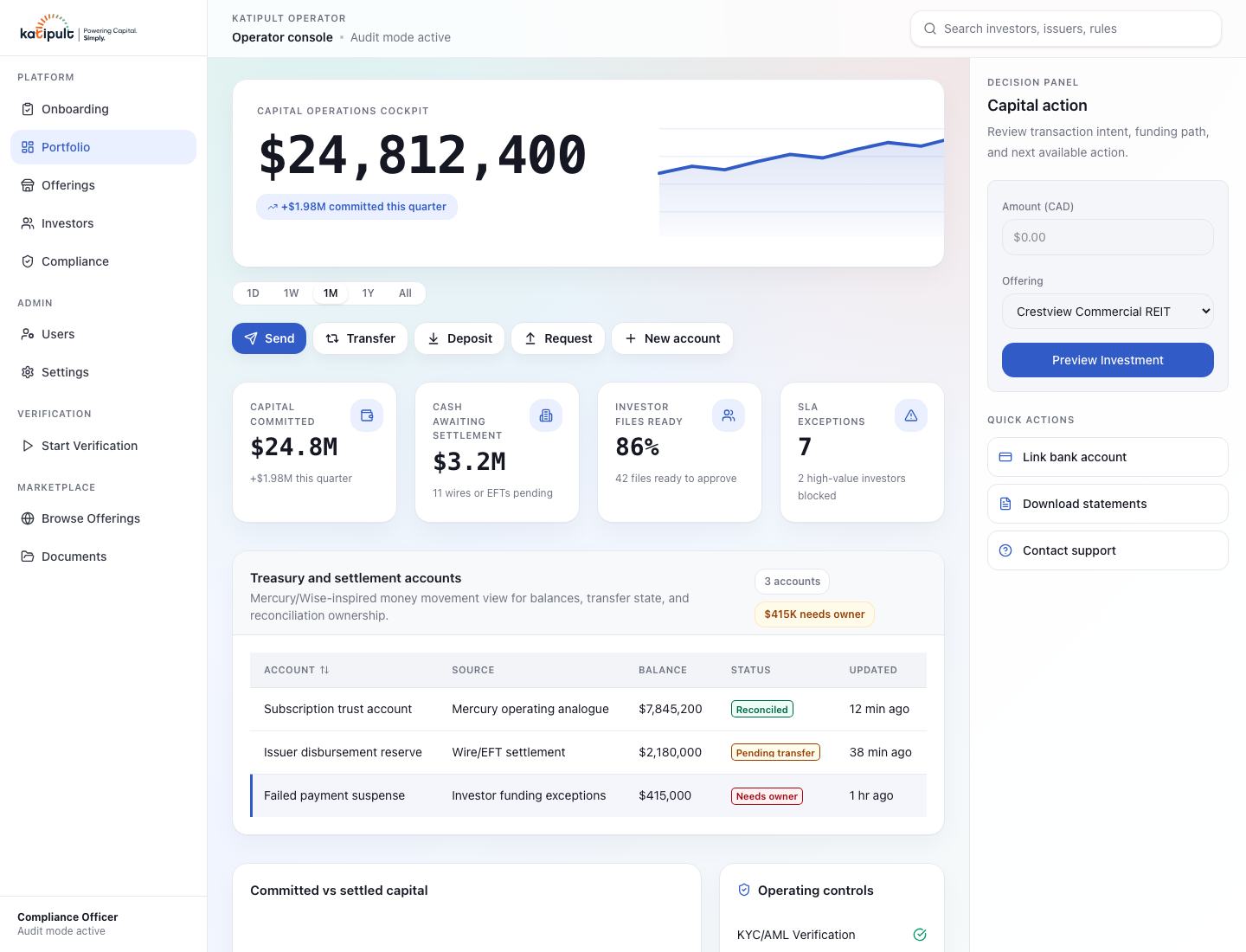
Capital operations cockpit showing investor portfolio overview with deal status, allocation totals, and compliance posture across tenants
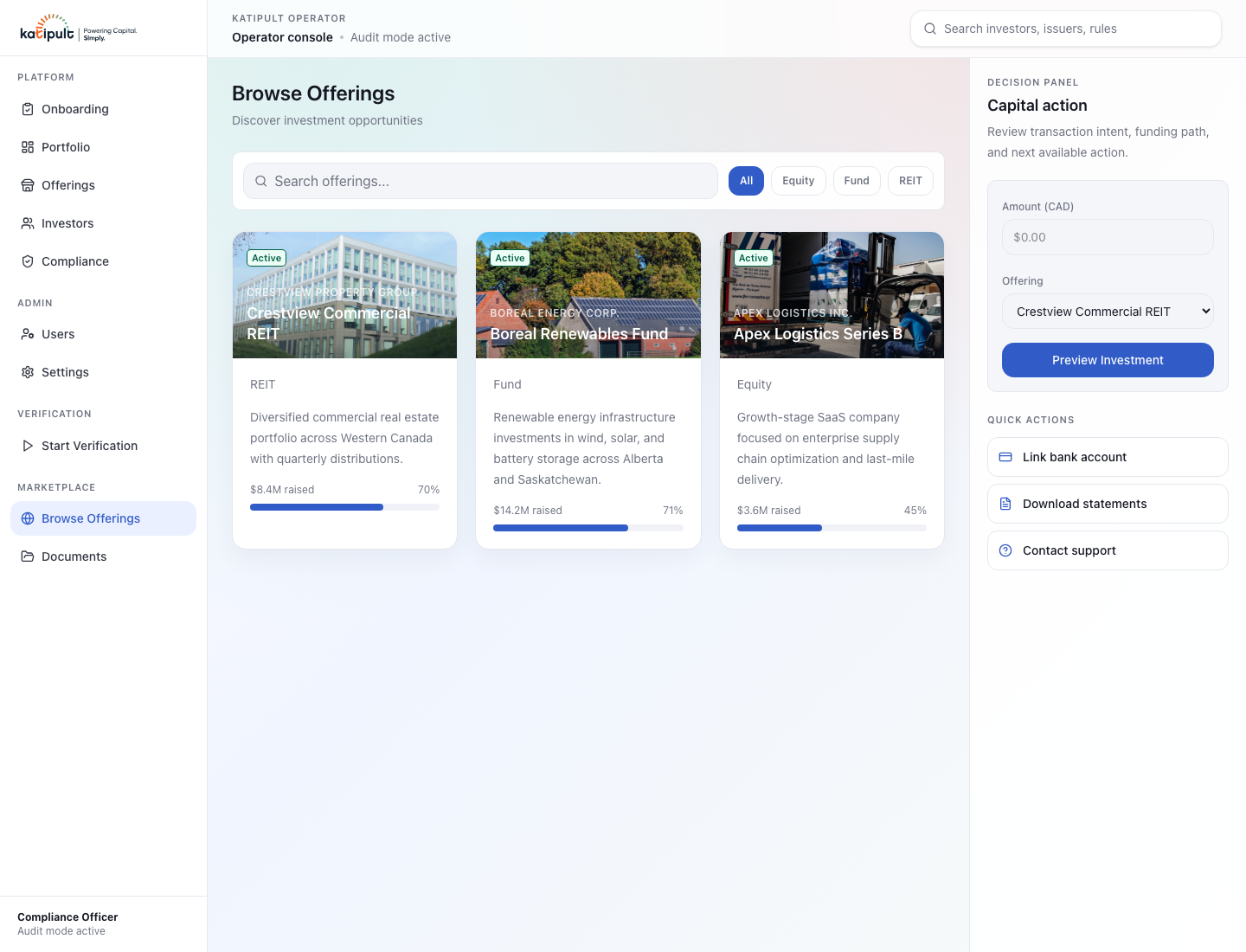
Lending and offerings marketplace showing deal listings with asset type, term, rate of return, LTV, days left, and raised progress across verticals

One engine.  Capital operations cockpit (left). Lending and offerings marketplace (right). Same compliance, identity, audit, and payments primitives shared across all three revenue segments.

Role
Co-founder and founding designer. Lead Product Designer 2014–2020 (DealFlow product depth). Head of Product Design 2020–2025 (platform-level pattern library, multi-tenant configuration UX, three-vertical expansion).
Timeline
This case focuses on 2020–2025 modernization era.
17-year company arc (2008 founding → 2017 TSX-V IPO → 2025 acquisition). Visuals shown are from the 2020–2025 platform modernization unless noted.
Team
3 people to 45 employees across Calgary, Vancouver, and Prague. TSX-V IPO 2017. Design practice kept lean — 2 full-time designers (Prague, Serbia) + external designers brought in as projects required. Design at the leadership table.
Anchor tenants
17 enterprise tenants across 6 continents. Three revenue segments (Debt & Lending, Canadian Equity, Global Equity) on one Katipult codebase.
TL;DR · 60-second read

Katipult is a single white-label engine that ships three revenue segments — Debt & Lending, Canadian Equity, and Global Equity — to 17 enterprise tenants across 6 continents on one codebase. Configurable brand tokens, jurisdictional rules, and feature flags swap per tenant. Audit-by-default. Multi-jurisdiction by design. The platform was the moat, not any single feature.

$2B+
Capital processed across 17-year platform lifetime.
$647M
Facilitated in 2023 alone. 71% YoY growth against market headwinds.
98%
Reduction in NIGO (not-in-good-order) documents.
17
Enterprise tenants on one codebase. 20+ jurisdictions, 3 product verticals.
( 01 )Direct contributions

What I personally designed.

  • Configuration engine. Designed the architecture — feature flags, tenant tokens, jurisdiction rules — that lets ONE codebase serve three revenue verticals (Debt & Lending · Canadian Equity · Global Equity) with no per-tenant code overhead.
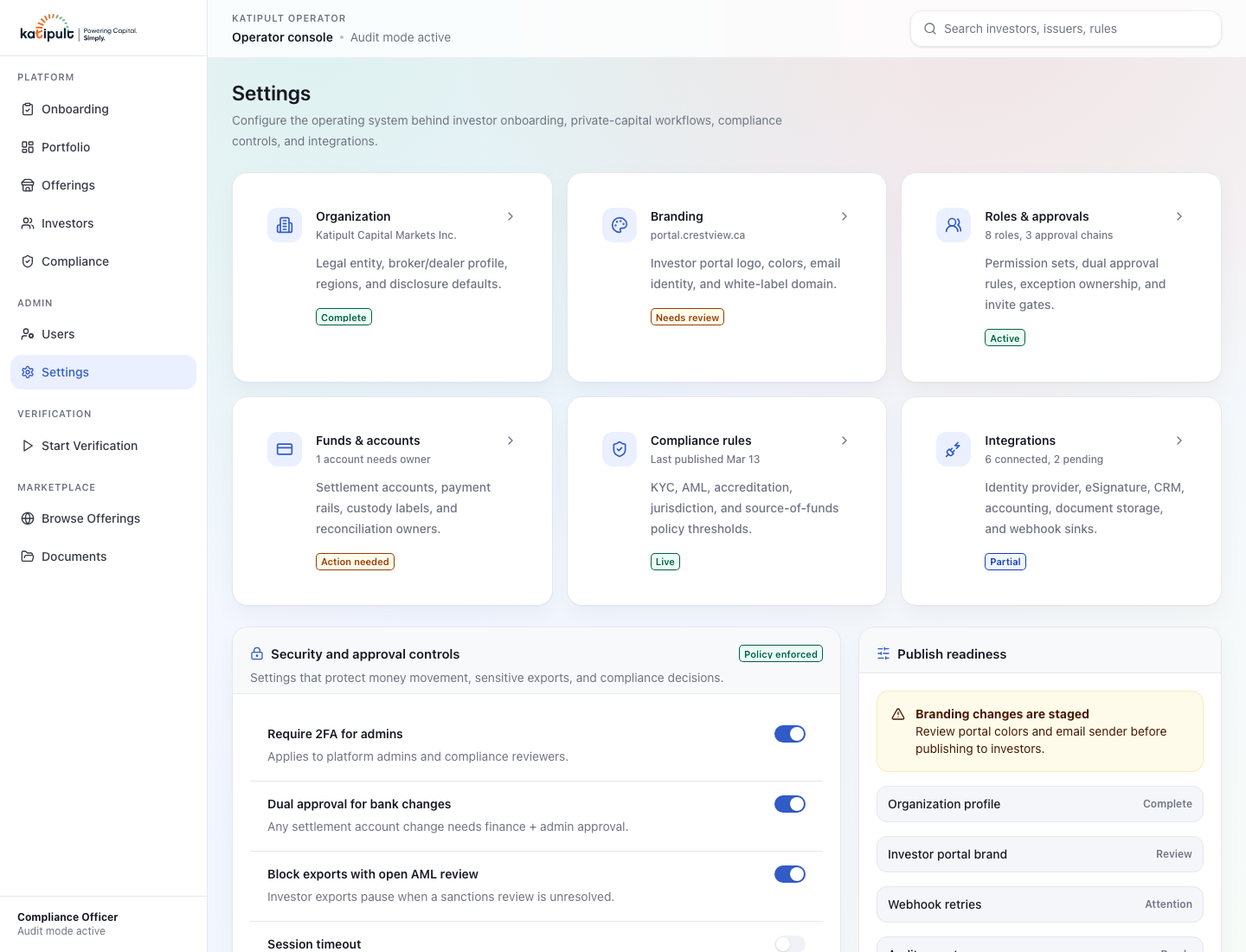
  • Tenant admin UX. Designed the white-label configuration interface so 17 enterprise tenants across 6 continents could set their own branding, jurisdictional rules, and feature toggles — without engineering touching the codebase.
  • Platform-level pattern library. Design system spanning DealFlow, Lending, and Donations & Rewards verticals.
  • DealFlow product depth (2014–2020). Investor onboarding, deal management, portfolio views. Vertical facilitated $647M in 2023 alone (71% YoY).
  • Lending vertical UX. Singapore, Mexico, UK, US deployments.
  • Donations & Rewards vertical UX. InvestYYC + Alberta BoostR (Calgary Arts Development, ATB Financial).
  • Founded and scaled the design practice. Kept the in-house team lean — 2 full-time designers in Prague and Serbia + a handful of external designers brought in as projects required.

Co-founded the company with two others. Cross-functional collaboration with engineering, compliance, legal, and the design team informed the work — but the platform-level design ownership across DealFlow, Lending, and Donations & Rewards was mine.

Desktop settings panel showing tenant configuration interface: jurisdictional rules, feature toggles, and brand tokens per deployment
( 02 )Problem

"Everything was done through email, so there was just a lot of room for error and things took way longer than they needed to." A senior dealer in my research, describing the pre-platform state.

Wrong amounts. Missing signatures. Expired accreditation. Investment dealers were managing private placements through email chains and spreadsheets. ECM teams spent weeks chasing documents instead of closing deals. Every handoff across the deal lifecycle was a manual spreadsheet, an email, or both. Ten stakeholders, twelve handoffs, no source of truth.

40%
of subscription agreements arrived NIGO (not-in-good-order) at quality-check stage.
6 wk
average time from offering announcement to closing — most of it document chase.
12
manual handoffs per deal across email, shared drives, and spreadsheets.
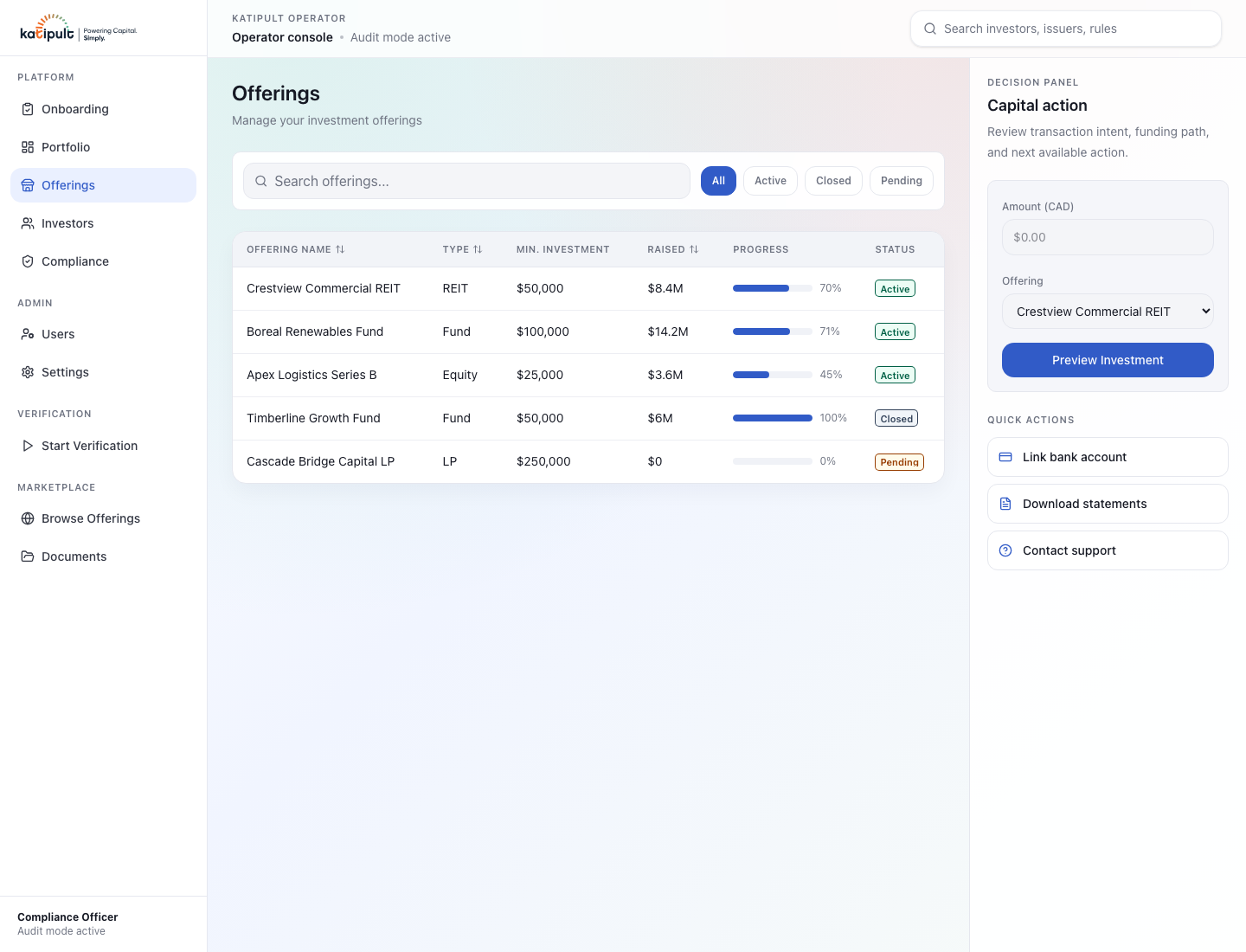
Desktop offerings management table showing the platform that replaced email-based deal management. Deal listings with status, allocation progress, and compliance indicators.
( 03 )Framing

Research surfaced the pattern across every dealer: the platform's value wasn't any single feature.

It was the elimination of every handoff. Dealers weren't paying for subscription agreement software or for offering wizards. They were paying for one source of truth that every stakeholder (ECM team, compliance, wealth management, legal, issuer, investor) could trust. The team framed the problem across three structural needs: issuers needed to launch offerings without waiting weeks for legal setup. Investors needed transparency into deal status and portfolio performance. Compliance needed every transaction auditable end to end.

The market context: $919B in annual private deal volume globally (World Bank / McKinsey). Private capital markets growing 8× since 2000 vs 3× for public markets. The digital infrastructure for that growth was almost entirely embryonic.

How might we

How might we replace email-based private placement management with an end-to-end platform that reduces close time by 48% and eliminates document errors, for investment dealers operating across multiple regulatory jurisdictions?

Capital operations cockpit showing the platform that answered the framing question. One source of truth for portfolio overview, deal status, allocation totals, and compliance posture.
( 04 )Solution

Katipult is a single configurable engine — multi-tenant, multi-jurisdiction, white-label by default. Three product verticals ship on it.

A / 01 · The platform

Katipult: white-label compliance and deal infrastructure

One codebase, 17 enterprise tenants, 6 continents. Brand settings, jurisdictional rules, and feature toggles swap per deployment. The engine stays unified. Migrating off Katipult meant rebuilding five separate vendor stacks — dealers stayed because the platform had absorbed the coordination problem.

Designed the multi-tenant configuration UX, brand-token pipeline, and platform-level pattern library.

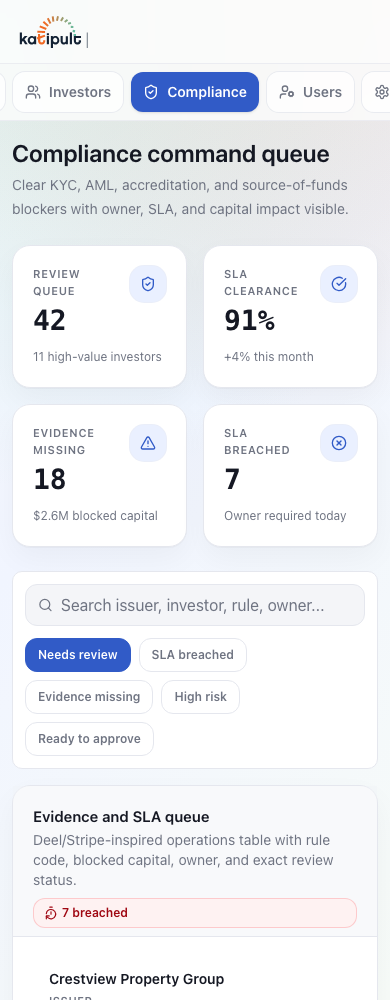
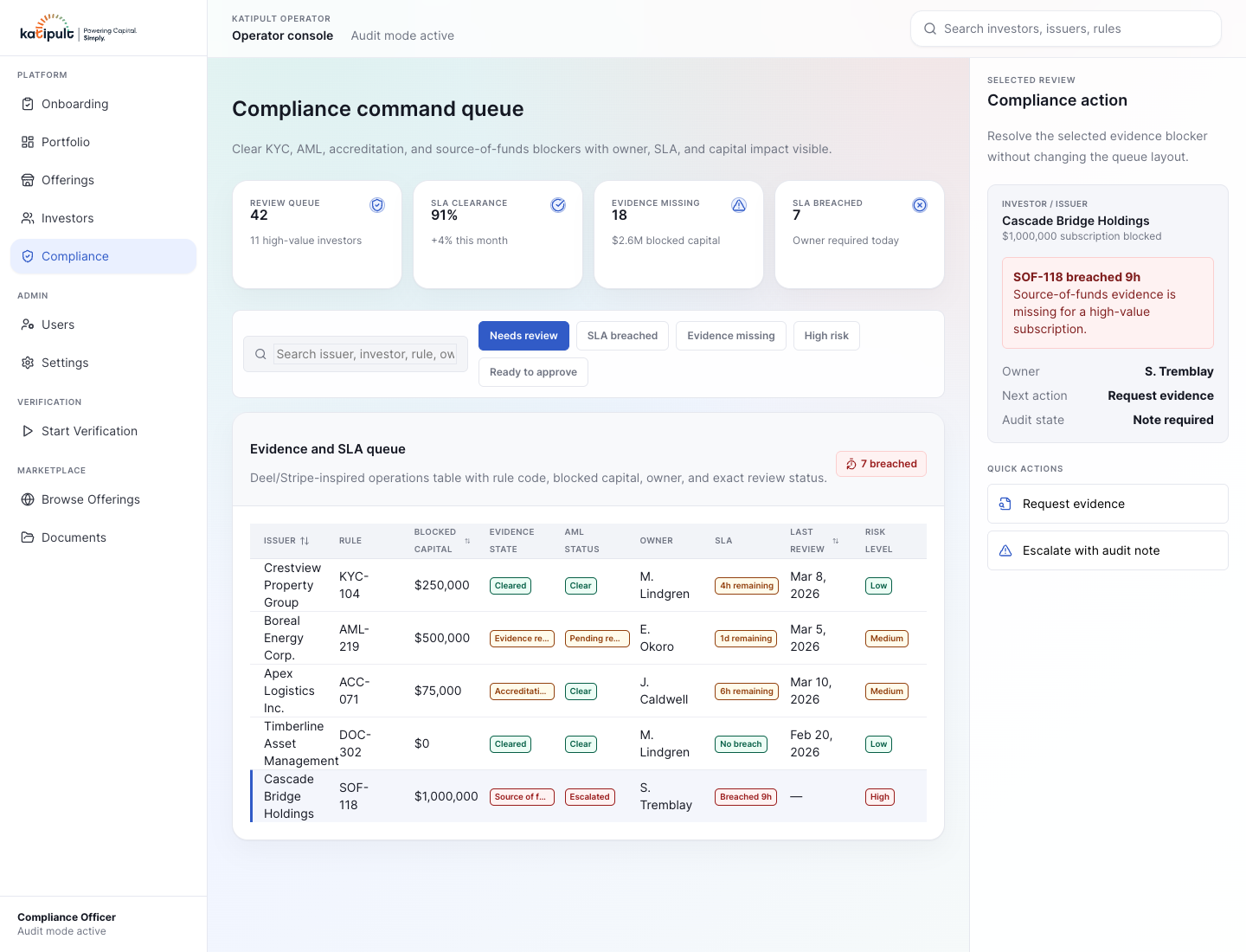
Compliance command queue desktop showing cross-tenant investor verification statuses, queued actions, and operator review controls
A / 02 · The flagship product

DealFlow — equity and capital markets on Katipult

Private placement deal management for institutional broker-dealers. Issuer onboarding, allocations, e-signature, and compliance reporting in one workflow. DealFlow Mesh launched 2023 as the industry's first private capital network — real-time book building across ECM, wealth management, law firms, and issuers. Backed by $510K NRC IRAP funding.

Lead PD on DealFlow 2014–2020. Designed the lifecycle state machine, operator triage queue, and Mesh book-building canvas.

Desktop offerings table showing the DealFlow product. Deal listings with asset type, term, rate of return, LTV, days left, and raised progress.
A / 03 · Three vertical instances of one engine

Debt & Lending · Canadian Equity · Global Equity

Three revenue segments, one codebase. Debt & Lending (small business + microfinance + P2P real-estate, e.g. Asterlend Singapore, BridgeKey Property Ireland). Canadian Equity (institutional placements + impact crowdfunding, e.g. Northpoint Impact). Global Equity (international land + impact + accredited cross-border, e.g. Hartwell Crowdvest UK, Pinevale Impact US, Pacific Crossing APAC). Compliance, identity, audit, and payments primitives shared across all three.

Designed the cross-vertical pattern library so a new vertical reused 80%+ of the existing primitives. Configurable rules engine + shared design tokens + tenant-scoped audit trail were the load-bearing decisions.

Lending product on Katipult: loan marketplace with 6-column listings showing asset type, term, rate of return, LTV, days left, and raised progress. Mirrors the LendR (ATB Financial) platform specification.
( 04.3 )Capabilities

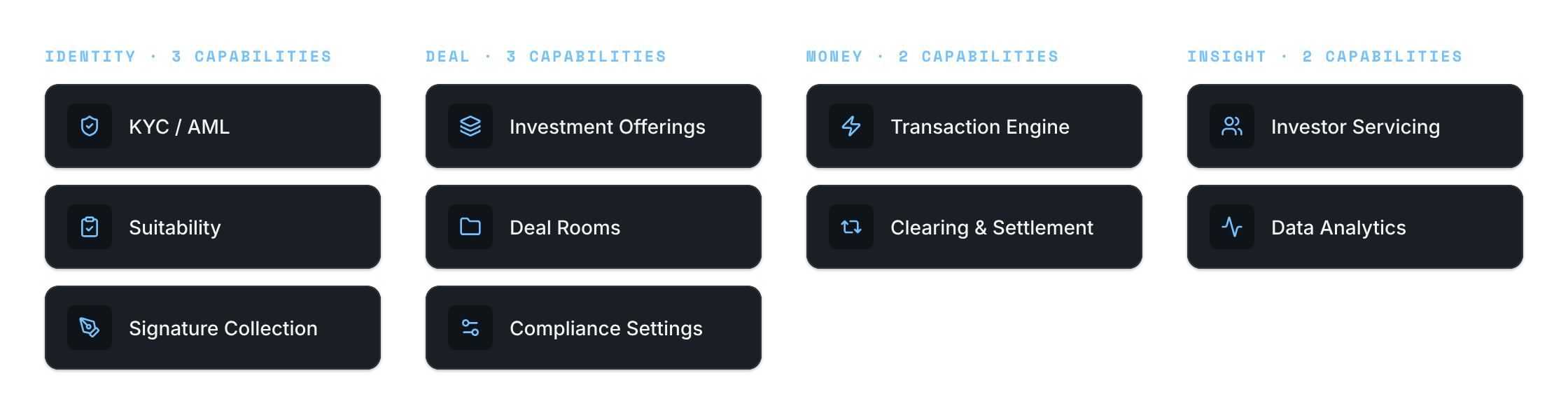
Every primitive a regulated deal needs, built into one platform with shared identity, shared audit, shared payments. Investors, issuers, broker/dealers, and legal teams operate from the same source of truth.

Katipult capability matrix showing 10 platform capabilities grouped into four categories: Identity (KYC/AML, Suitability, Signature Collection), Deal (Investment Offerings, Deal Rooms, Compliance Settings), Money (Transaction Engine, Clearing and Settlement), and Insight (Investor Servicing, Data Analytics)
( 04.5 )The Moat

Same engine. Six tenant brands. Zero forks.

The same operator surface, configured for six enterprise tenants. Brand color, type system, corner radius, accent saturation. All swap per deployment via design tokens. Underlying data model, validation gates, audit trail, and compliance rules engine stay unified. This is what shipped to 17 enterprise tenants on one Katipult codebase.

Capital raising
Ridgeline Securities Private markets desk
Allocation review

Boreal Renewables III

Institutional private placement
$14.2M committed of $18M
79%
  • 12 institutions
  • Reg D + NI 31-103
  • Closing book open
Lending
Northcap Wealth Advisor lending portal
Collateral review

Lakeside Heights Loan

Senior secured borrower file
$7.9M principal requested
64%
  • 8.4% target yield
  • LTV 58%
  • Borrower docs due
Real estate
Crestview Property Group Property income platform
Funding open

Crestview Commercial REIT

Western Canada income portfolio
$8.4M raised of $12M
70%
  • REIT units
  • Quarterly distributions
  • Occupancy 94%
Equity
Mossbrook Capital Growth equity room
IC memo ready

Apex Logistics Series B

Growth equity subscription room
$6.8M soft circled
57%
  • Lead investor pending
  • Data room active
  • Board package attached
Debt
Westbridge Capital Cross-border credit
Jurisdiction routing

BridgeKey IE Note

Cross-border private credit product
11.2% gross coupon
42%
  • Irish borrower
  • MiFID II track
  • FX hedge required
Donations
Prairie Arts Foundation Giving campaign portal
Match window live

Prairie Voices Campaign

Donor-funded cultural program
$92K pledged of $150K
61%
  • 312 donors
  • ATB match enabled
  • Tax receipts ready

17 tenants on this engine. The above shows six. Onboarding a new tenant: configure tokens, toggle products, scope jurisdictions, deploy. No codebase fork, no design-system rebuild, no per-tenant pattern library.

( 04.7 )Process

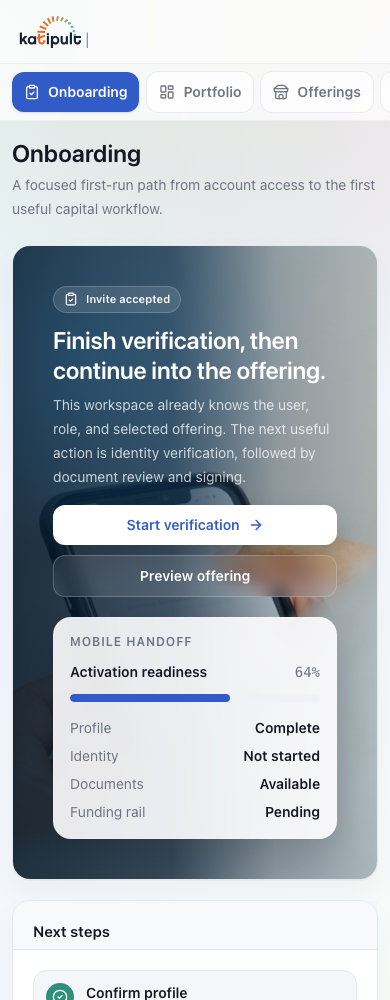
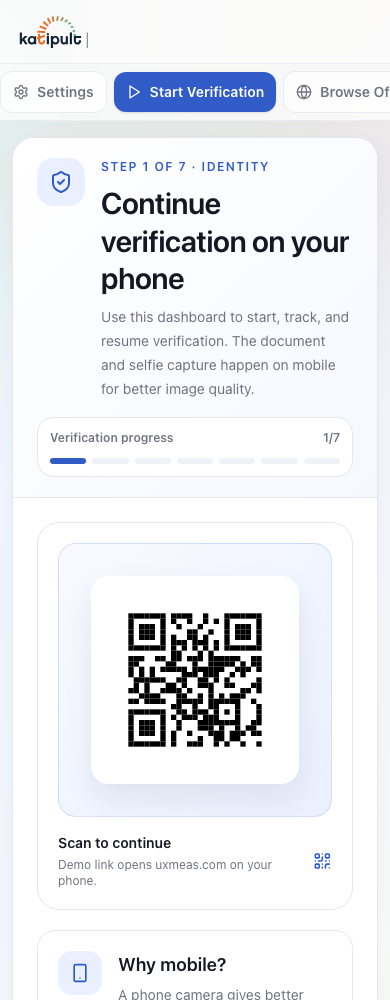
Three decisions on mobile. Same compliance flow, three different jurisdictional contexts. The platform routes investors through only the steps their jurisdiction and accreditation status actually require.

Mobile onboarding flow showing investor account setup with jurisdiction and profile entry steps.
Jurisdiction

One decision per screen

Legal residence, tax residence, and citizenship separated into three discrete decisions. Single-question screens kept abandonment under 5% on this step.

Mobile KYC start screen prompting investor to begin identity verification with document upload options.
Accreditation

Evidence as progressive choice

Accredited investor proof routed by status (income, net worth, institutional). Progressive disclosure shows only the documentation required for the chosen path.

Mobile compliance summary screen showing investor KYC status, accreditation tier, and document checklist in a fixed table layout.
E-signature

Sign on the device you started on

9-step e-sign ceremony optimized for mobile completion. Document preview, identity bind, audit trail. ESIGN/eIDAS-compliant by default.

( 05 )Key Screens
Latest capital operations cockpit
Latest lending and offerings marketplace
( 06 )Results
Platform scale

$2B+ capital processed across the platform's lifetime (2008-2025). 17 enterprise tenants across 6 continents on one Katipult codebase. 20+ regulatory jurisdictions. Three revenue segments (Debt and Lending, Canadian Equity, Global Equity) shipping on the same engine with zero per-segment codebase overhead.

Method: $2B+ aggregated from internal platform throughput logs across all tenants over 17 years.

2023 performance, DealFlow vertical

$647M facilitated in 2023 (71% YoY vs $378M in 2022, against market headwinds). $545M from enterprise tenants alone (up from $318M). 55% more deals launched YoY. 19,018 transactions. Average transaction value grew from $48K to $78K (+63%).

Method: Annual rollup from platform transaction database. 2023 = full calendar year. Audited as part of TSX-V public reporting.

Operational impact

48% faster deal close (median time from offering launch to closing day). 98% reduction in NIGO documents (40% baseline to under 1% post-platform). End-to-end workflow replaced spreadsheet-and-email handoffs with a single auditable source of truth. 47% to 85% investor onboarding completion rate.

Method: NIGO baseline measured pre-platform via dealer self-report; post-platform via in-app validation gate logs. Onboarding completion measured against Trulioo + internal KYC funnel.

Three-vertical proof

Same Katipult engine, three segments: Debt and Lending (small business + microfinance + P2P real-estate; e.g. Asterlend Singapore, BridgeKey Property Ireland) · Canadian Equity (institutional placements + impact crowdfunding; e.g. Northpoint Impact) · Global Equity (international land + impact + accredited cross-border; e.g. Hartwell Crowdvest UK, Pinevale Impact US, Pacific Crossing APAC, Stoneferry Wealth Ireland). International deployments still operational years after initial launch.

Katipult portfolio dashboard showing investor's active deal positions, capital deployed, and return metrics across all holdings.
( 07 )Reflection

What worked

Architecture as a business decision. A configurable white-label platform meant 17 enterprise tenants ran on one codebase with zero per-tenant overhead — that was the moat. Three revenue segments (Debt & Lending, Canadian Equity, Global Equity) shipped on the same engine because the design system, identity layer, and audit trail were tenant-aware from day one.

Design at the leadership table from a 3-person startup through TSX-V IPO and acquisition demonstrated that UX leadership drives revenue in enterprise fintech, not just usability scores.

The design work outlasted the company. BridgeKey Property (P2P property investment, Central Bank of Ireland-regulated, 8,000+ investors), AvviaCapital (Italian equity crowdfunding, MiFID-compliant), and Lighthouse Venture Exchange (Toronto innovation hub) are all still operational on Katipult years after launch.

What to do differently

Formalized UI kit and pattern library from year one, not year five. The first five years were ad-hoc components that created consistency debt requiring full audits before each major tenant launch.

Earlier structured user research. The founding team relied on intuition and tenant feedback for too long before establishing formal research practices — research arrived in year four when it should have arrived in year one.

Cleaner separation between investor-facing onboarding and admin-facing deal management from the product architecture level. The two workflows got tangled in the same information architecture for years before being split into distinct surfaces.